How to Check Herbal Tincture Ingredients Before You Buy
Last Updated: October 31, 2026
Quick Summary
To check herbal tincture ingredients, read the back label in this order: ingredient list, plant part, solvent, ratio, batch number, then allergens. Each herb should be named separately with its own quantity or ratio, and the solvent and plant part should be stated. A batch number links your bottle to a test record.
- A 1:5 ratio means one part herb to five parts solvent; a 1:2 is stronger.
- Ask the maker for the certificate of analysis for the batch you are buying.
- UK food labelling rules require allergens to be emphasised in the ingredient list.
- A label saying alcohol-free should still show what replaced the alcohol.
- An incomplete label is a red flag, so treat the product as unknown.
Table of Contents
- Start With the Ingredient List, Not the Front Label
- How to Read Herbal Supplement Labels Line by Line
- Herbal Tincture Alcohol Content and Other Solvents
- What the Herb-to-Solvent Ratio Tincture Figures Actually Mean
- Herbal Tincture Quality Testing: What Evidence to Ask For
- Checking Ingredient Identity and Authenticity at Home
- When a Tincture Label Is Incomplete or Unclear
- Choosing Your Next Bottle With Confidence
- Frequently Asked Questions
Start With the Ingredient List, Not the Front Label
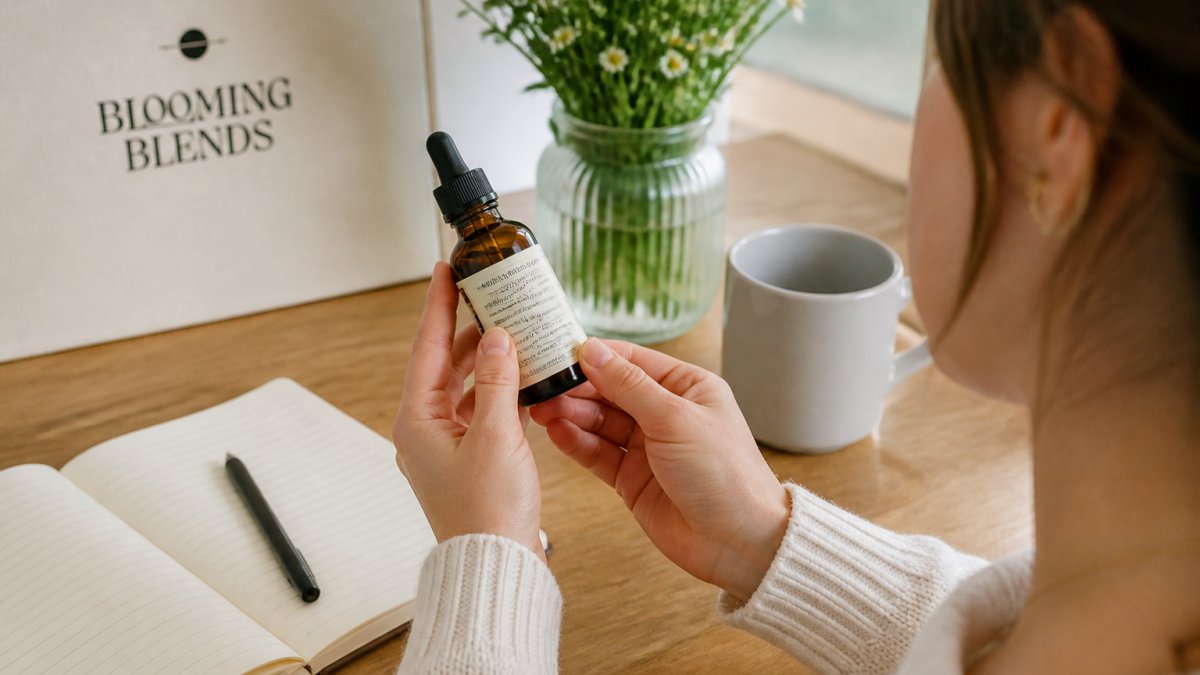
The front of a bottle sells a feeling. The back tells you what you are actually taking. If you want to know how to check herbal tincture ingredients, turn the bottle around and start with the ingredient list.
A herbal tincture is a liquid botanical extract made by soaking plant material in a solvent, usually alcohol, glycerine or vinegar, so the plant's compounds pass into the liquid. At Blooming Blends, our tinctures are alcohol-free and finished with glycerine made from UK-grown rapeseed.
The front label is marketing, and the back label is the product. Learn to read the back and you can judge any bottle with more confidence.
How to Read Herbal Supplement Labels Line by Line
Read a herbal supplement label in this order: ingredient list, plant part, solvent, ratio, batch number, then allergens. Each line answers a different question, and skipping one lets a weak or unclear product slip through.
Work through it like this:
- Ingredient list - Are the herbs named, or hidden behind a "blend"? A label that says "proprietary blend" without disclosing amounts per herb makes it hard to check what you are taking. Look for each herb listed separately with its own quantity or ratio.
- Plant part - Root, leaf, bark, flower or seed? Each behaves differently. A label that says only "echinacea" without specifying root or aerial parts is incomplete; the root and the leaf are different products with different compounds.
- Solvent - Alcohol, glycerine, vinegar or water. The solvent should be named, and for alcohol the strength is usually shown as a percentage (for example, 25% ethanol). If the solvent is not named, you cannot tell what kind of extract you have.
- Ratio - The herb-to-solvent figure, if shown. A 1:5 means one part herb to five parts solvent; a 1:2 is stronger. If no ratio is given, you cannot compare strength between bottles.
- Batch number - A sign the maker tracks its production. It links your bottle to a test record. No batch number, no trail.
- Allergens - Declared clearly, not buried. In the UK, food labelling rules require allergens to be emphasised in the ingredient list, so a maker that buries them is not being careful.
Botanical Names and Plant Parts: What the Latin Tells You
A botanical name removes all doubt about which plant you are getting. "Echinacea" could mean several species; Echinacea purpurea means one. Good labels print the Latin name and the plant part, because root and leaf are not the same product.
When a label lists a plant part, it tells you what was actually harvested. That matters for quality and for how the herb was prepared. If you want to see how a transparent maker names and sources its herbs, our page on the herbs we use shows the full list.
A common mistake is assuming a pretty Latin name means a tested ingredient. It does not. It only means the plant is identified.
Spotting Undisclosed Additives and Allergens
Additives hide in the words "natural flavouring" and "other ingredients". A clean tincture needs very little beyond herb, solvent and water. If the list runs long, ask why.
Watch for these:
- Sweeteners beyond the stated glycerine
- Preservatives not declared by name
- Colours or flavourings with no source given
- Allergens such as celery or nuts, which should be flagged
Allergens should be declared clearly and not buried in the ingredient list. If something is not named, you cannot check it.
Read a herbal supplement label in this order, because each line answers a different question.
| Label line | What to check | Why it matters |
|---|---|---|
| Ingredient list | Each herb named separately with its own quantity or ratio | A "proprietary blend" without amounts makes it hard to check |
| Plant part | Root, leaf, bark, flower or seed stated | Root and leaf are different products with different compounds |
| Solvent | Alcohol, glycerine, vinegar or water named, with strength as a percentage | If the solvent is not named, you cannot tell what extract you have |
| Ratio | Herb-to-solvent figure such as 1:5 or 1:2 | Without a ratio you cannot compare strength between bottles |
| Batch number | A batch number present | It links your bottle to a test record |
| Allergens | Declared clearly, not buried | UK food labelling rules require allergens to be emphasised |
Herbal Tincture Alcohol Content and Other Solvents
Herbal tincture alcohol content is the single most overlooked line on a label. Traditional tinctures often use ethanol as the solvent, and the strength is usually shown as a percentage. If you avoid alcohol for medical or personal reasons, that number matters.
Solvents do different jobs:
- Alcohol extracts many compounds and preserves well
- Glycerine makes a sweet, alcohol-free extract
- Vinegar suits some plants but is milder
- Water alone extracts the least
New to tinctures? Our guide to what herbal tinctures are explains how alcohol-free, glycerine-based versions are made before you judge a label's claims.
Watch out: a label saying "alcohol-free" should still show what replaced the alcohol. If it does not, you cannot tell whether the bottle is a real extract or mostly water.
What the Herb-to-Solvent Ratio Tincture Figures Actually Mean
The herb-to-solvent ratio tincture figure tells you how concentrated the extract is. A 1:5 ratio means one part herb to five parts solvent. A 1:2 is stronger; a 1:10 is weaker. The lower the second number, the more plant per drop.
This is where strength and concentration get confused. A high-strength tincture is not automatically better; it depends on the herb and the dose. What the ratio gives you is a fair way to compare two bottles of the same plant.
If you are unsure how much to take, our guide on how to take herbal tinctures daily covers dosage and timing, which helps you read these figures in practice.
Herbal Tincture Quality Testing: What Evidence to Ask For
Herbal tincture quality testing separates a serious maker from a bottler. Ask what testing was done and whether a certificate of analysis exists.
A certificate of analysis typically includes:
- The botanical name and plant part tested
- The batch number it relates to
- The test methods used (for example, HPTLC, DNA barcoding or HPLC)
- The results, often as a pass or fail against a specification
- The date of testing and the laboratory that performed it
You can ask a maker for the certificate of analysis for the batch you are buying. A good maker will provide it or explain why it is not available. If a maker cannot tell you what testing was done, treat the product as unverified.
The research backs this up. Separately, quality control research on herbal drugs describes DNA barcoding as a gold standard for identifying medicinal plants.
A batch number is worth looking for, as it can link your bottle to a test record.
Checking Ingredient Identity and Authenticity at Home
You can check ingredient identity at home, but only up to a point. You can confirm the label is complete, the plant part is stated and the solvent is named. You cannot confirm chemical identity without a lab, and any guide claiming otherwise is overselling.
Use this checklist:
- Latin botanical name printed
- Plant part stated
- Solvent named with a percentage
- Ratio shown
- Batch number present
- Allergens declared
- No vague "blend" hiding doses
If every box is ticked, the maker is being open. That is the strongest signal you can get without testing.
When a Tincture Label Is Incomplete or Unclear
An incomplete label is a red flag, not a puzzle to solve. If the herb, plant part or solvent is missing, you cannot verify the product, so treat it as unknown rather than assume the best.
Some gaps are fixable with a quick question. A good maker will tell you what is in the bottle and where it came from. If you are weighing up a bottle and the details are thin, you can contact Blooming Blends and ask directly.
A label that will not answer a simple question is answering it for you.
Choosing Your Next Bottle With Confidence
Confidence comes from evidence, not from the front label. Once you can read the ingredient list, name the plant part, identify the solvent and check the ratio, you can compare any two bottles on fair terms.
That is the standard we hold ourselves to. Our alcohol-free tinctures are made in small batches, with no tablets, fillers or binders, and finished with naturally sweet glycerine made from UK-grown rapeseed. Each blend is designed to support moments of rest, calm, digestion or everyday wellbeing, and our customers rate them highly, including a 4.9 for NIGHTTIME and a 5.0 for DIGESTION.
You do not need a laboratory to shop well. You need a label that tells the truth. Browse our alcohol-free herbal tinctures and read the ingredients for yourself.
Frequently Asked Questions
How can you tell what is actually in a herbal tincture?
Read the full ingredient list on the back label, not the marketing text on the front. It should name each plant by its botanical Latin name as well as its common name, state which plant part was used (root, leaf, flower or berry), and list the solvent. Independent research has examined how often listed ingredients in commercial herbal products need verifying. If the label lists only a proprietary blend with no amounts, ask the maker for a certificate of analysis before buying.
Do tinctures contain alcohol, and how do I check?
Many traditional tinctures use ethanol as the solvent, so alcohol content is worth checking if you avoid alcohol. Look for the words ethanol, ethyl alcohol or alcohol by volume (ABV) on the label. Alcohol-free options usually use glycerine or vinegar instead, and the label should say so plainly. If a brand claims to be alcohol-free but will not confirm it in writing, treat that as a warning sign. Ask for the specification sheet, which states the solvent and its percentage.
What does the herb-to-solvent ratio on a tincture label mean?
The ratio, written as something like 1:3, tells you how much dried herb went into each part of solvent by weight. A 1:3 tincture is stronger than a 1:5 because more plant material is packed into the same volume of liquid. A 1:1 preparation is a fluid extract and is the most concentrated form. Compare ratios only between products made from the same plant part, since a root and a leaf behave differently in extraction.
How do you know whether a herbal tincture is good quality?
Ask for three things: a batch number on the bottle, a certificate of analysis from the maker, and evidence of testing such as HPTLC (high-performance thin-layer chromatography) or DNA barcoding. DNA barcoding is one method sometimes used to authenticate medicinal plants. Reputable small-batch makers will share this on request. Also check the shelf life and storage instructions, and confirm the bottle lists the plant part and solvent clearly rather than hiding behind a proprietary blend.
Reading a label should feel simple, and it can be. Start with the ingredient list, check the plant part and solvent, then look for a batch number. If a bottle cannot answer those basics, it is not worth your money.
At Blooming Blends, we make that check easy: full ingredient listings, alcohol-free glycerine bases and small-batch production you can ask us about. Get started with Blooming Blends and choose a tincture you can actually verify.